
The Funded Trader Honest Review & Challenge Comparisons

The Funded Trader is one of the top prop firms in the industry right now. With more than $20 million paid out and hundreds of 5-figure payouts. But with 3 different challenges, and lots of similar prop firm competition, it may be hard deciding if The Funded Trader is right for you. That’s why in this review I’ll discuss every detail you need to know about The Funded Trader, and compare it to alternatives like FTMO, My Forex Funds and Funded Trading Plus.
The Funded Trader Discount Code
If you do choose The Funded Trader use the discount code TPJ for 5% off any challenge!
The Funded Trader also frequently runs other limited time discount promotions, with higher percentages off and other added benefits. If you want to find the latest discount codes for The Funded Trader and other prop firms, join the official Prop Journalist Discord Server. Prop firm discounts are found in the limited time discount time codes channel, and you can be notified whenever a new code is posted by reacting to the message in the welcome channel.

I’d always recommend checking the discord server before making a purchase from TFT, because 90% of the time you can save money with a discount code found in the server!
The Funded Trader Reputation
The Funded Trader has a very good reputation, and while it isn’t as old as FTMO, it has rapidly collected more than 2,500 reviews on Trustpilot with a 4.9 star rating overall. There are lots of payout proofs posted in the TFT discord, which has over 35,000 members.

The 3 The Funded Trader challenges and what makes them unique
So it’s clear The Funded Trader pays out when you make a profit, but which challenge should you choose? TFT offers 3 different challenges:
- Standard Challenge
- Rapid Challenge
- Royal Challenge
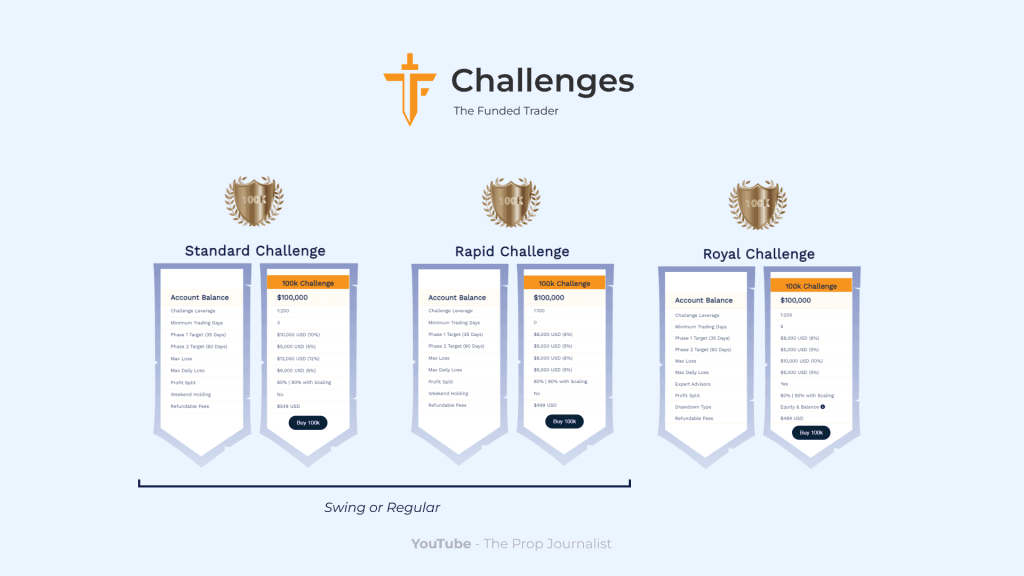
Standard and Rapid have swing and regular account options to choose between. All The Funded Trader challenges are split into 2 phases:
- Phase 1 with a larger profit target in 35 days
- Phase 2 with a smaller profit target in 60 days
If you don’t reach the profit target but end any phase in profit you are eligible for a free retry, where you will start back at Phase 1. Once you pass both phases you receive a funded account, where you are eligible for 80% of the profits that you make, which can be increased to a 90% profit split after scale-up. The main selling points of each one are the following:
- The standard challenge has the largest 12% maximum drawdown
- The rapid challenge has the lowest 8% phase 1 profit target and 0 minimum trading days
- The royal challenge allows EA trading and has no lot size limits unlike the standard and rapid funded accounts
But some of these selling points aren’t what they first seem, I’ll explain more as I go more in depth about each of the challenges
The Funded Trader Standard Challenge
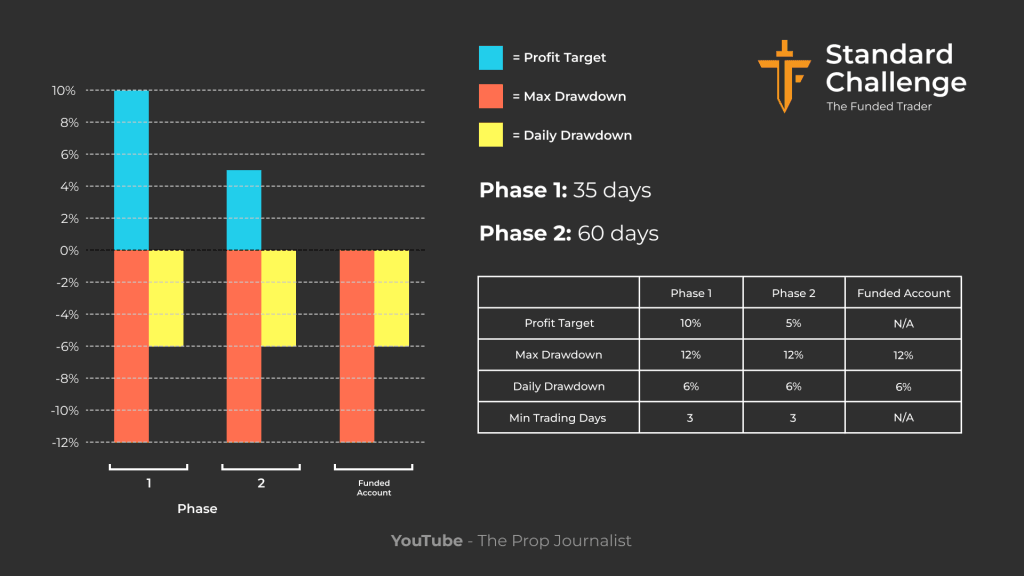
The standard challenge has the largest drawdown parameters, with 12% maximum and 6% daily drawdown, but is the most expensive challenge. Due to fluctuations in the EURUSD exchange rate, the $100k TFT standard account is similar price to an $100k FTMO. However, The Funded Trader offers larger $400k accounts, which are cheaper than 2 $200k FTMO accounts. My Forex Funds evaluations are still the cheapest of the three, but only offer accounts up to $300k. However, all three have a $600k maximum funding limit, so if you are going for that My Forex Funds is still the cheapest.
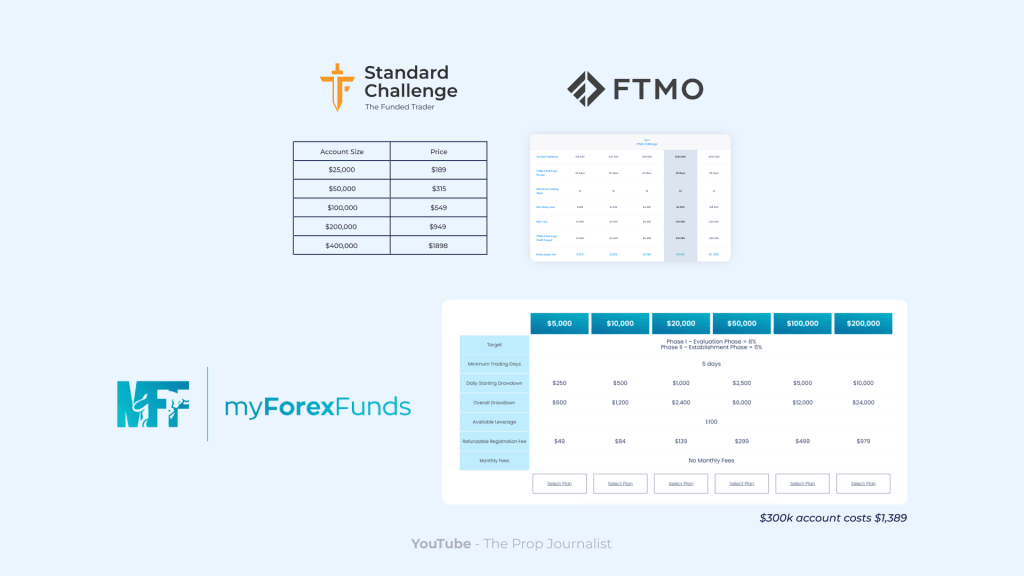
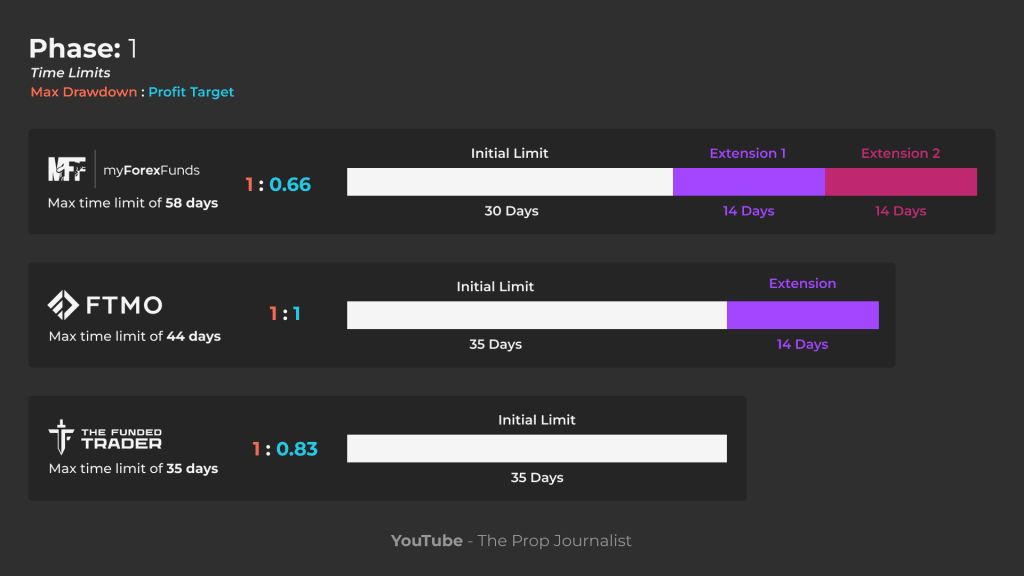
The 10% profit target in phase 1 and 5% profit target in phase 2 are the same as FTMO’s targets, but the funded trader standard challenge is easier due to having larger drawdown. But My Forex Funds has an even lower phase 1 target of 8%, a drawdown to profit target ratio of just 1:0.66.

While My Forex Funds only offers 30 days to reach the phase 1 target, any trader with 6% or more profit at the end is eligible for a 14 day extension. So theoretically the My Forex Funds phase 1 could be split into 2 parts, first a 6% target in 30 days, then a 2% target in 14 days. The My Forex funds extension can go all the way up to 4 weeks total too. FTMO also offers a 14 day extension, requiring just 5% profit after 28 days to activate. So overall in phase 1 The Funded Trader has the lowest time limits if you include time extensions.
The main advantage of the TFT standard challenge over My Forex Funds used to be daily drawdown calculated by balance only, but this has been changed so they are calculated the same way with both equity and balance.
Swing vs regular

If you do choose to take the TFT standard challenge, the next choice is between the swing and regular accounts. The difference is that swing standard accounts can hold over the weekend but have 1:60 leverage, while regular standard accounts can’t hold over the weekend but have 1:200 leverage.
Payouts
Traders with standard funded accounts can request a their first payout 30 days after they place the first trade on the funded account. For future payouts it takes only 14 days since the first trade was placed after the previous payout date.
Scaling Plan

Once you are funded with the TFT standard challenge, you have the potential to scale up all the way to $1.5m. In order to scale up, you need to make a return of 6% in 3 months, with at least 2 of the 3 months being profitable. Traders must make at least 2 withdrawals during these 3 months too. If you achieve this, your account will increase by 25% of the original account balance. You can continue achieving these targets every 3 months and scaling up, but keep in mind each account increase is always 25% of the original account balance, so account scaling does not compound. For example, if a trader scales up a $100k account once it will increase to $125,000 and then if they scale up again the account will go up to $150,000, then again up to $175,000.
The Funded Trader Rapid Challenge
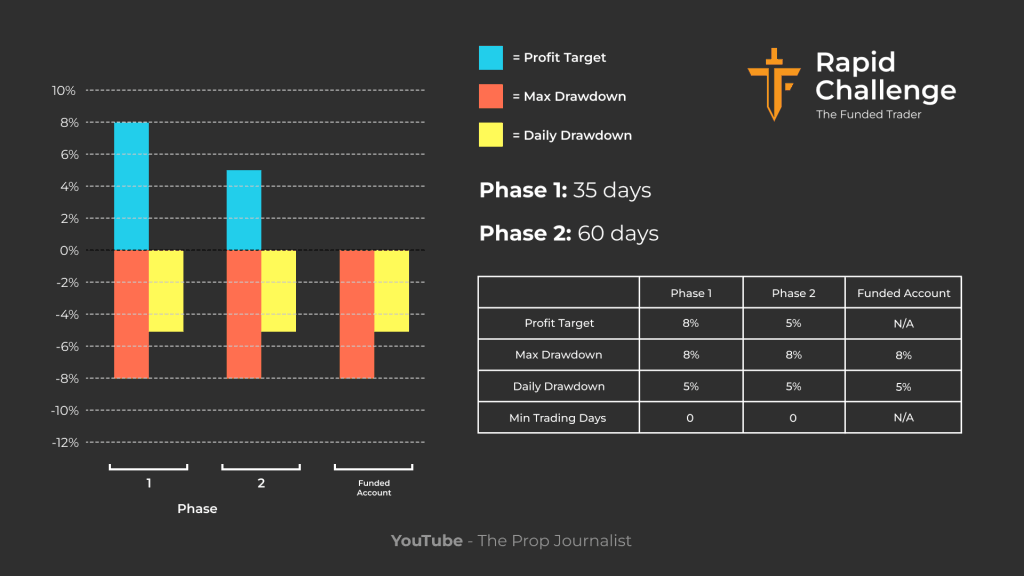
Now onto the Rapid Challenge. Originally the selling point for this challenge was the lower profit target of 8%, and 0 minimum trading days so that you can get funded fast. However, there is a problem. The maximum drawdown for the rapid challenge is much lower than standard, with only 8% maximum drawdown and 5% daily drawdown. While this is reflected in the slightly cheaper evaluation fee, this loss of drawdown makes the rapid challenge harder to pass than the standard challenge.
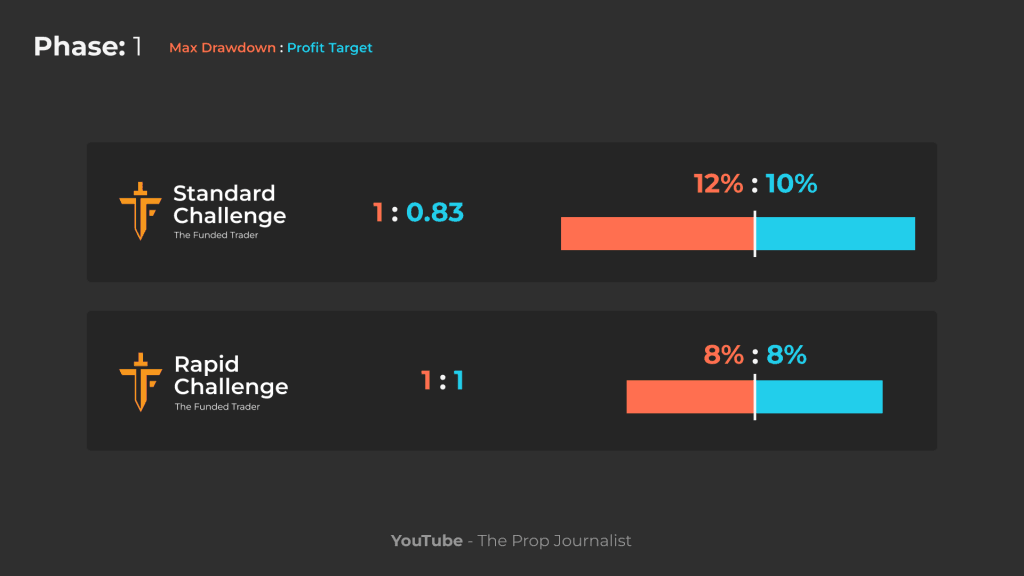
This is due to a much higher drawdown to profit target ratio for each phase due to the lower maximum drawdown. Despite having a lower profit target of 8%, phase 1 of the rapid challenge has a 1:1 drawdown to profit target ratio, while the standard challenge has a 1:0.83. This means that the rapid challenge has a larger profit target in comparison to maximum drawdown than the standard challenge, meaning it’s actually harder to pass. This is the same in phase 2, where the ratios are 1:0.63 and 1:42, once again showing the rapid challenge is harder to pass.
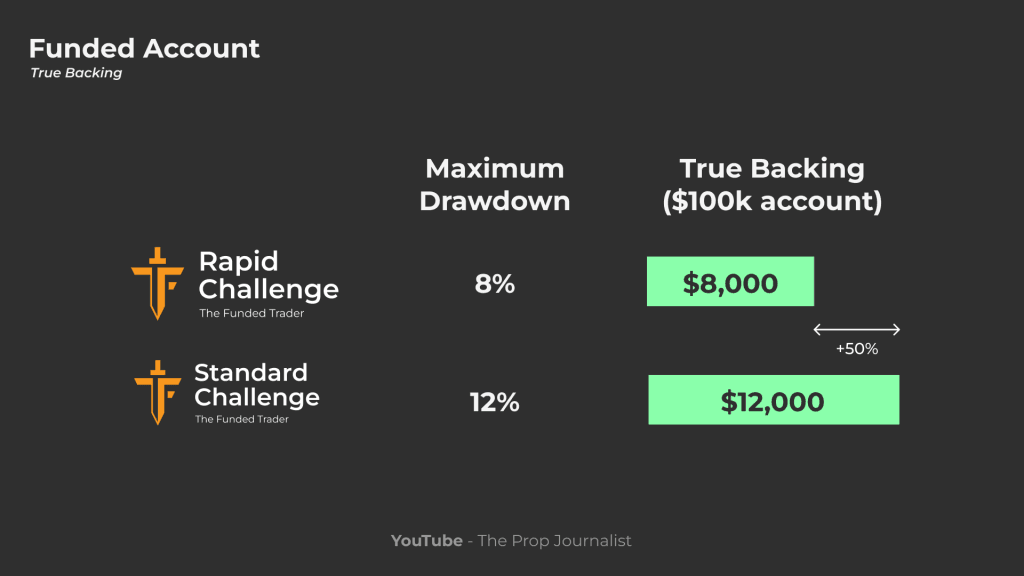
This extra difficulty mitigates any benefit the rapid challenge’s cheaper evaluation fee has because it’s actually easier to get the more expensive fee refunded with the standard challenge. Also once each challenge is passed, the standard funded account has an extra 50% true backing due to the larger maximum drawdown.
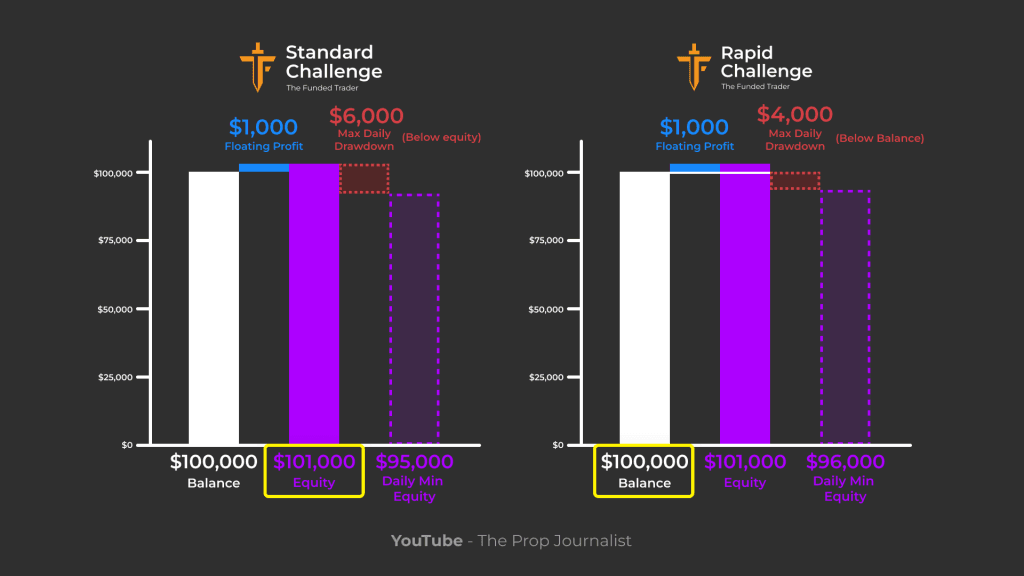
The real advantage of the rapid challenge is that its daily drawdown is based on balance only, unlike the other two TFT challenges, as this rule was changed for standard challenges in October. But because daily drawdown is only 4% compared to 6% on standard accounts, whenever floating profit is less than 2% of the account the standard daily drawdown is still better. There is also the benefit of 0 minimum trading days, but this isn’t much of a difference compared to the 3 minimum on the other challenges.
Swing vs regular

There is also the option between a swing and regular account for the rapid challenge. The regular rapid account can’t hold trades over the weekend but has 1:100 leverage (this is half the leverage of the regular standard account), while the swing rapid account can hold trades over the weekend but has 1:30 leverage (again half the leverage of its standard counterpart).
Scaling Plan

The scaling plan for rapid accounts works differently to the standard account scaling plan. You can scale up once a month, and the only requirement is to make a withdrawal of 10% of the account’s initial balance in one profit split. This requirement stays the same, but if you withdraw a profit split of less than 10% of the account’s initial balance, it won’t contribute to scaling at all. When you scale up the rapid account, it will increase by 10% of the initial account balance. For example with a $100k account, the first scale up will increase it to $110k, then the second to $120k, and so on.
Payout
Rapid funded account payouts can be requested 14 days after placing the first trade. The profit split for rapid accounts is initially 80%, but can be increased to 90% if during any 3 month period you qualify for scaling in 2 out of 3 months. This minimum 20% profit is much harder than the standard and royal scaling plans, which only require 6% profit over 3 months.
Lot size limits (Standard and Rapid Funded Accounts)
The Funded Trader doesn’t enforce any lot size limits during challenges, but once funded with a standard or rapid account on Eightcap there is a 5 lot size limit on indeces. If you want to avoid this either choose a purple trading for the broker when buying a standard or rapid account, or go for the royal challenge.
The Funded Trader Royal Challenge
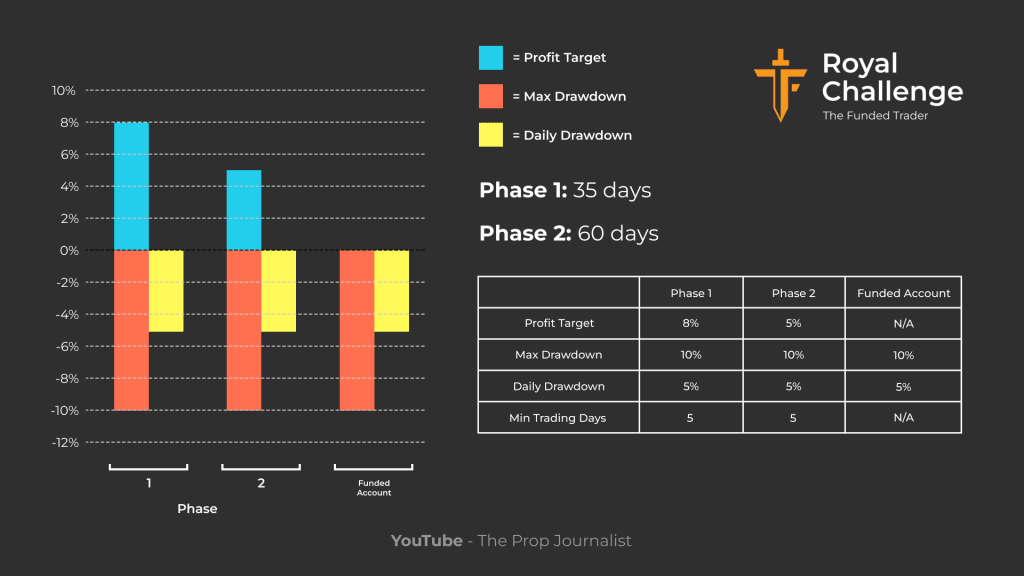
If you don’t want to deal with lot size limits on the Funded account or need to use an EA to trade, the Royal Challenge is the best pick. It’s cheaper than Standard accounts, while still having high 1:200 leverage and a 80% profit split that can be increased to 90% with scaling. It has the same profit targets as the standard challenge of 8% in phase 1 and 5% in phase 2 but it has lower drawdown of 10% maximum and 5% daily. Also the minimum trading days higher at 5, but the main disadvantage of the royal challenge is its daily drawdown rule.
It is calculated using both equity and balance, compared to the standard and rapid accounts which only use balance. If you want to learn more about this equity and balance drawdown, see my post on My Forex Fund’s daily drawdown rule because they work the same way. The problem with this rule is that it considers floating profit when calculating daily drawdown. So if there is an open trade in profit at 5pm EST when the drawdown is calculated, and the trade reverses, decreasing floating profit, this can violate the daily drawdown rule, even if no loss is made on the account.
This rule is a problem for traders who hold high risk to reward trades overnight, but can be avoided by reducing risk percentage and using a trailing stop. You can hold trades over the weekend with the royal challenge, but this can be risky due to the daily drawdown rule.
Scaling Plan
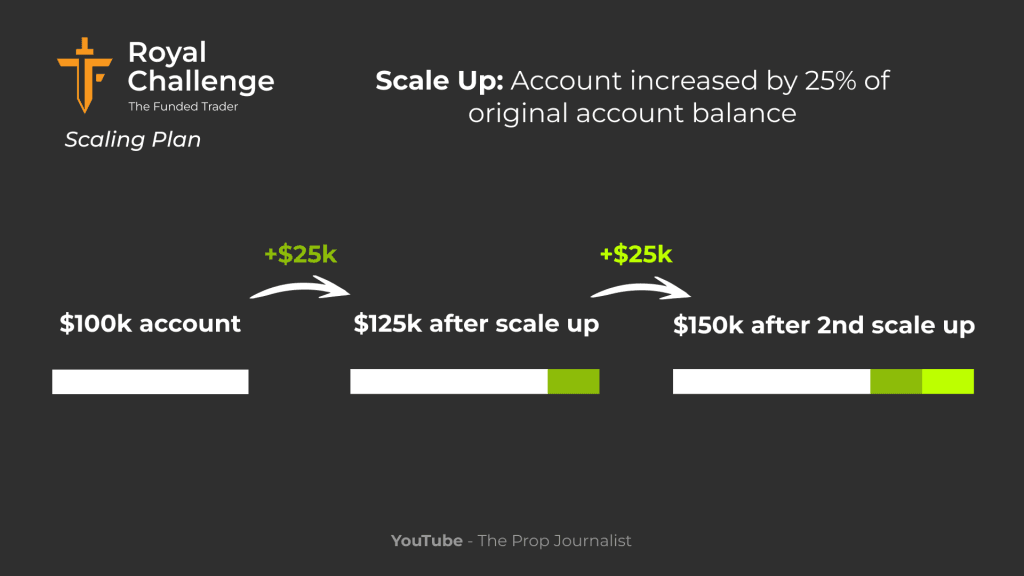
The Royal challenge scaling plan works the same as the standard challenge scaling plan. It has the same requirements to scale up every 3 months, and increases by 25% of the original balance each time.
Payout
The first payout for royal accounts can be requested 30 days after the first trade is placed, and then subsequent payouts are biweekly.
General TFT Details
News trading

News trading is not restricted on challenge accounts, but on some funded accounts, it is not allowed. On regular standard and regular rapid funded accounts, you can’t trade within 2 minutes before or after red folder news events. This includes opening and closing market orders, and any stop losses or take profits being triggered. If you breach this rule you will be issued a warning and have any profits made during the time window removed, and on the 3rd breach of this rule you will lose your account.
Spreads and commissions
The Funded Trader charges $5 per lot commissions, but has tight spreads to make up for it, with EURUSD averaging around 0.2 pips.
Maximum Account Allocation
There is no limit on the number of accounts you can have, but the maximum original value of your accounts can’t exceed $600k. However, this can be increased to a maximum of $1.5 million with scaling up.
Withdrawal Methods

TFT offers payouts from Deel, as well as BTC, ETH and USDC crypto
Competitions

The Funded Trader runs monthly trading competitions which are free to enter, offering cash prizes and free challenges to winners. This month the first prize is $6k cash and a 200k royal challenge, with prizes all the way up to 50th place. These competitions are free to enter, with maximum daily drawdown of 5% and max total drawdown of 10%. The aim is to receive the highest return in the month without breaking the drawdown rules. This is great to test out the TFT trade hub platform, and you can even earn some free challenges if you do well.
Future Features
The Funded Trader is planning on bringing out trading accounts directly through TradingView and an instant funding model. Make sure to subscribe as I’ll be covering all important changes to The Funded Trader in future videos.
Conclusion
So, which The Funded Trader funding model, if any, is right for you? The most important question is whether balance only based daily drawdown is necessary for you.
If this is the case, the choice is between the TFT rapid challenge and FTMO. The rapid challenge does have lower maximum drawdown so therefore lower true funding, but with it you can hold trades overnight unlike FTMO and the 0 minimum trading days compared to 10 is a great benefit too. The rapid challenge is also cheaper than FTMO, even more so with 7% off using discount code TPJ.
If you don’t mind equity and balance based drawdown, the Standard and Royal challenges offer higher daily and maximum drawdown, meaning higher true funding. Their main competition is My Forex Funds which has a lower phase 1 drawdown to profit target ratio and low prices. But with discount code TPJ, the 400k standard account comes in significantly cheaper than 2 MFF 200k accounts, if you don’t mind the extra 2% phase 1 profit target. The Funded Trader also has better trade execution than My Forex Funds, as MFF’s average slippage of 0.4 pips can hurt traders with small stop losses. If this makes you choose The Funded Trader, I’d recommend the standard challenge over the royal challenge. it is slightly more expensive, but the drawdown to profit target ratios are similar, and the extra drawdown is very beneficial, especially given that daily is based on equity and balance so you want it to be high. If you want an alternative with no time limits for the evaluation, I’d recommend The Funded Trader, make sure to watch my full review of it and use discount code TPJ10 for 10% off.
Thanks for reading


